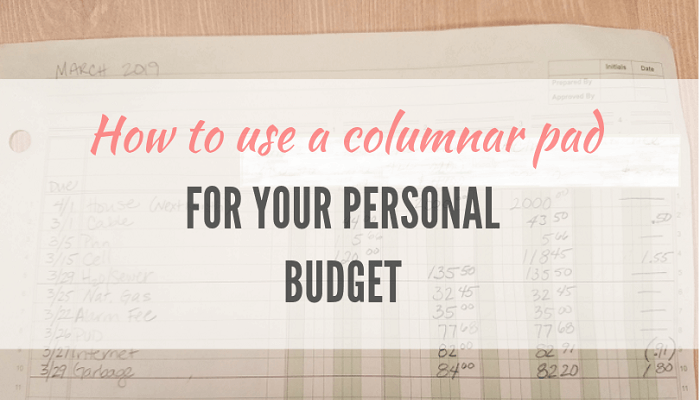
Ever wondered how to use a yellow financial pad for your budget?
I did. When I started actively planning our budgets, I wanted something that wasn’t necessarily on the computer, something I could physically stick under my husband’s nose and get him to look at and review. A legal pad wasn’t cutting it for me. I liked the order that came with yellow accounting pads, with all those perfect little lines and columns. But I had NO idea where to start if I was going to use one for personal use. I think I found one grainy photo online and puzzled it out. So without further ado...
Here’s a quick tutorial on how to use a yellow columnar sheet.
Two last disclaimers here – First, I’ve played around a little and adapted this for our use, and what works best for my brain. After a few months with this, you may find you want to do that too. There’s no right or wrong way to do this - it's not like you've got a job or a grade riding on “perfect” use. Perfect is the enemy of good. Second, I’m using some representative figures here, not our actual income or bill amounts. While I want to be transparent in what I write here on the blog, there are still some things I want to keep private. Using representative numbers still shows very clearly how to do this.
Let’s get started.
Let’s lay the foundation of your monthly budget with some categories and basic information. Note the month up in the corner, and then in header area of the widest column, write “Income.” In columns 1 and 2, you’re going to note your paychecks. Before you get all excited and write stuff down and then have to erase later (Did I remind you to do this in pencil? No? Remember to use pencil!), let me explain the other columns - column 3 will be for "Actual" expenses, and column 4 will be your "Variance," to see how your actual differs from your plan.
In the income columns, I write either our initials, or full names if I’m feeling saucy. I also note the dates that those dollars are expected to come in. As I mentioned above, I’m using some representative figures here, but I wanted to show what this really looks like.
Plug in your income.
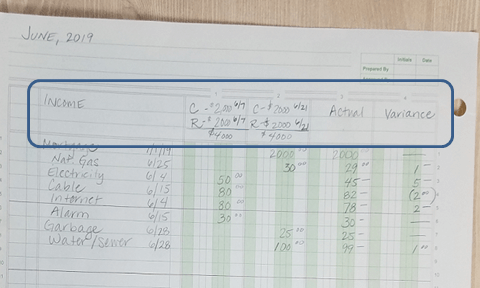
Note – your paydays may or may not line up together. Ours don’t. Sometimes I group them together so that they line up by one of the dates. My husband gets more deposits in a month than I do, so I just figure that by the date that my first one comes in, he will have deposits 1 and 2 in the account, and I put his combined total of those two deposits on his line, with the same date. For example, $1,000 deposited on the 7th and $1,000 deposited on the 14th would be combined into $2,000 by 6/15, coinciding with the first check of the other person. We only have so many columns, and this makes it simpler as we go. Note that I use one line for me, one for him, and the bottom line in this box for the combined total.
Group and list your expenses.
Down the left-hand column, I want you to note your expenses. The little sections on these yellow sheets make it easier to group them together into categories, though you might have some spill over if you have more than five items in a group. You’re going to have one line for each biller or item. Housing is your most important, so put that down first. That’s your mortgage or rent payment, and any separate bills you have that are related to your housing – HOA dues, etc. My next category is utilities– water and garbage, electricity, gas, TV, etc. The next group is food (groceries, eating out and school lunch), followed by transportation (gas and oil, parking, insurance and tolls), lifestyle & entertainment (haircuts, pet costs, gifts, clothes, gym) and lastly, debt. Don’t forget your autopay items!
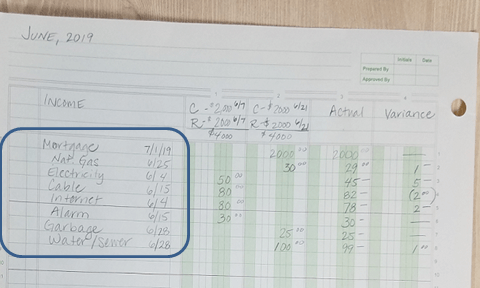
and note the date the bill is due
Look at what you paid last month, or if you’ve already received this next month’s bills, what you’ll be paying for each item. List them out in the column under the paycheck(s) that will pay each bill. For example, a Visa bill due on the 24th of the month will go into the June 15th paychecks column, but a water bill due on the 8th will need to be paid for with funds that are in your account on the 1st of the month (or somewhere thereabouts).
How do I budget for bills due before the first paycheck?
Sometimes it’s hard to think about an item being paid on the first of the month, when you may not get your first paycheck of that month until the 7th, or some other day that isn’t the exact FIRST. For those, I recommend playing a bit of a mind game, and figuring in “next month’s” payment. So as I budget for June, I’m planning on July’s mortgage payment, because I’ll need to have money ready to go before that bill is due. (See example in image above.) Make sense?
Once you’ve listed everything, total up each column, and subtract it from the income up in the top row. As your month goes on, go back in at least once a week and fill in Column 3 with whatever the ACTUAL costs were for the item in each row. In column 4, note the difference between what you budgeted and what the actual amount spent was – did you come in under and have money left over, or did you go over budget?
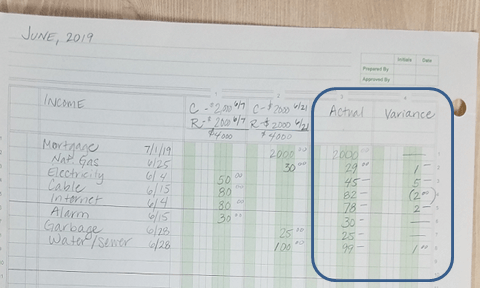
the difference from what you budgeted.
Assess and adjust, if necessary.
Adjust your month’s variable spending down if necessary, to stay on plan. Knowing the reality of your monthly bills will help you get better next month, and you’ll got more and more dialed in on this as you go.
There you have it! A step-by-step tutorial on how to do a personal budget with a yellow columnar pad. Go forth and budget!